Library & Information Centre
The most pitiable person, according to Benjamin Franklin is one who caught in a house without books on a rainy day. This diagnosis for happiness and entertainment made by this scholar and statesman three centuries ago holds good even today. If educational institutions are the temples of learning, the Library is the sanctum sanctorum. Nirmala true to its motto “Knowledge Purifies,” has accorded a prime place to the adobe of books. Housed in a modern and aesthetically well-designed multi-storeyed building, it evokes in one’s mind the colosseum at Rome of the ancient times. The library offers a feast to the intellectual appetite to satiate young minds.
The library is the most frequented place in the college both by students and by the members of the staff. It houses 64232 Books, 150 Journals and Magazines both National and International. It caters not only to the needs of Undergraduate and Postgraduate students but also to the requirements of the research scholars. The library is fully computerized with bar coding facility and the books are classified by Dewey decimal classification.
The OPAC system enables the students to check the availability, status and the exact locations of the books. The barcoded ID cards help to systematize the day-to-day book transactions. Library is a three-storeyed building, and is fully automated with a wide collection of the latest Books, Periodicals and CDs, which is updated every year. The library, which has an open-access system, uses technology in efficient and innovative manner. The Digital library functions in a networked environment, and maintains two servers and over 58 PCs to support its various operations and services.
Electronic resources such as INFLIBNET- N List, NPTEL, J-Gate and eLib4U are made available to all members of the library via the internet and the College intranet. The library also hosts DELNET, a digital repository of research. The main objectives of DELNET are to promote resource sharing among the member libraries by collecting, storing and disseminating information and provide networked services to researchers and scholars to supplement their research activity. It contains published articles, syllabi, conference papers, question papers, theses and other related documents, with full text wherever possible.
The library also houses rare books, and articles authored by faculty of the college. Ready reference books like encyclopedias, yearbooks, and dictionaries are also available on the ground floor. The digital library is used for orientation programmes, seminars and programmes on research methodology and training in the use of various databases.
Area
The carpet area of the Library is about 20,200 Sq. feet.
Working Hours
The Library established in the year 1948. It covers an area of 20200 Sq.ft.
Weeks days – 8.30 a.m to 5.00 p.m
Saturdays – 9.00 a.m to 1.00 p.m
The library is closed on Sundays and other public holidays
Rules
All students of the college should be members of the library
Strict silence should be maintained in library.
Books will be issued to the students only on presentation of the Identity Card
Book bank books will be issued to the needy and poor students on request.
The use of reference books should be within the Library. The reference books will not be issued at any cost.
Students must scan their Identity Card (ID) before entering the library.
Exchange of ID cards is not permitted.
Students must immediately report the loss of their ID card to the Librarian.
Books will be issued or renewed only if the student produces her identity card
Students are not allowed to bring any printed matter or files into the library.
Books must not be marked or damaged in any manner.
Students must examine each book before borrowing and immediately report any damaged or missing pages to the Librarian.
Students shall replace or pay for the cost of any book lost by them. If one book of a set is lost or damaged the whole set shall be replaced.
Seating Capacity
The Library has a seating capacity for 250 users.
Nine members of staff are available in the library to cater to the information needs of the college community.
-
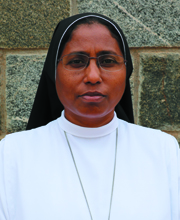
DR.SR.M.JACULINE MARY
Librarian
-
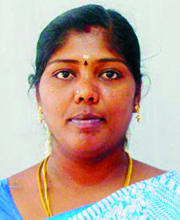
M.SATHYA
Librarian (SF)
-
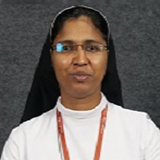
Sr. Arockia Saranya
Librarian
-
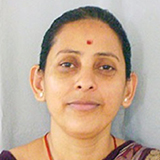
Prameeta Sharma
Librarian
Membership
All the students,faculty and administrative staff of the College are the members of the Library. The Nirmala College Library also extends its membership to retired faculty and visitors.
Collection
Method of classification: Dewey Decimal Classification.
A separate theses section is available in the Library which holds M.Phil and Ph.D theses.
Library Collections
GENERAL:
| Books | 64232 |
| Text Books | 58267 |
| Reference Books | 5965 |
| Book Bank | 4660 |
| Journals | 92 |
| Back Volumes | 16282 |
| Newspapers | 4 |
| Magazines | 65 |
| CD/DVDs | 309 |
| Theses & Dissertations | 514 |
| Map | 70 |
Rare Collections:
Rare Collection
Special Collections:
-
Career Guidance
-
Competitive Examinations
-
Foreign Languages
-
Fine Arts
-
Health Education
-
Yoga & Meditation
-
Value Education
-
Directories & Yearbooks
-
Question Bank
-
Online Database (E-Journals)
E-Resources
-
INFLIBNET – N-LIST
-
DELNET
-
NISCAIR
-
SAGE
-
D-LINE
-
IUP-ICFAI
-
NPTEL
-
J-GATE
-
eLib4u
E-Books
Links to free e-books
E-journals
-
https://doaj.org/
-
http://www.benthamscience.com/
-
http://journal.chemistrycentral.com/
-
http://www.academicjournals.org
-
http://www.ias.ac.in/
-
www.dline.info/jnt
-
www.dline.info/jic
-
www.dline.info/jisr/
-
www.dline.info/jci
-
www.dline.info/jmpt
-
www.sciencedomain.org/
-
www.springeropen.com/journal
-
www.paperity.org
-
www.scirp.org
-
https://www.nlist.inflibet.ac.in
E-theses: Links to Shodhganga & ETD
SERVICES & FACILITIES
Library Services
-
Computerization of Library services
-
OPAC Online Public Access Catalogue
-
Orientation programme for the students
-
Book Exhibitions
-
Reference services
-
Display of new arrivals
-
Competitions
-
Research Corner
-
Current Awareness Services
-
Book bank Scheme
-
Career Guidance
-
Reprography Services
-
Audio Visual Presentation
-
Safety measures (CCTVs)
-
Suggestion Box
-
Audio Visual facility
-
Internet Access
-
Sapientia club for motivating and encouraging reading habits among students
-
E-content recording and facilitating Media centre
-
Interactive panel for teaching and learning
-
URKUND (Ouriginal) Software for Plagiarism Detection
AUTOMATION
Library Services
-
Acquisition System
-
Cataloguing System
-
Circulation System
-
Serials Control System
-
Reference services
-
OPAC (Online Public Access Catalogue)
-
Stock Verification
-
Online User Entry
-
Current Awareness Services
-
Transaction Report
MOOCS
SWAYAM
SWAYAM is a programme initiated by Government of India and designed to achieve the three cardinal principles of Education Policy viz., access, equity and quality. The objective of this effort is to take the best teaching learning resources to all, including the most disadvantaged. SWAYAM seeks to bridge the digital divide for students who have hitherto remained untouched by the digital revolution and have not been able to join the mainstream of the knowledge economy. SWAYAM or Study Webs of Active – Learning for Young Aspiring Minds programme of Ministry of Human Resource Development, Government of India, Professors of centrally funded institutions like IITs, IIMs, Central Universities offer online courses to citizens of India. It is an instrument for self-actualization providing opportunities for a Life-long learning. Here learner can choose from hundreds of courses, virtually every course that is taught at the university/ college/ school level and these shall be offered by the best teachers in India and elsewhere.
NPTEL
The National Programme on Technology Enhanced Learning (NPTEL) was initiated by seven Indian Institutes of Technology (Bombay, Delhi, Kanpur, Kharagpur, Madras, Guwahati and Roorkee) along with the Indian Institute of Science, Bangalore in 2003. Five core disciplines were identified, namely, civil, computer science, electrical, electronics and communication, mechanical engineering and 235 courses in web/video format were developed in this phase. The main goal of NPTEL Phase II (2009-14) was to build on the engineering and core science courses launched previously in NPTEL Phase I. An additional 600 web and video courses were created in all major branches of engineering, physical sciences at the undergraduate and postgraduate levels and management courses at the postgraduate level. Several improvements such as indexing of all video and web courses and keyword search were implemented.
URL: https://nptel.ac.in/